sexta-feira, 3 de fevereiro de 2012

New meteorological theory argues that the world's forests are rainmakers


Jeremy Hance
Read more at mongabay.com
February 01, 2012


The Amazon rainforest meets cleared area for cattle pasture. A radical meteorology theory argues that loss of forest, both in temperate and tropical regions, will lead to less precipitation over land. Photo by: Rhett A. Butler.


New, radical theories in science often take time to be accepted, especially those that directly challenge longstanding ideas, contemporary policy or cultural norms. The fact that the Earth revolves around the sun, and not vice-versa, took centuries to gain widespread scientific and public acceptance. While Darwin's theory of evolution was quickly grasped by biologists, portions of the public today, especially in places like the U.S., still disbelieve. Currently, the near total consensus by climatologists that human activities are warming the Earth continues to be challenged by outsiders. Whether or not the biotic pump theory will one day fall into this grouping remains to be seen.


 First published in 2007 by two Russian physicists, Victor Gorshkov and Anastassia Makarieva, the still little-known biotic pump theory postulates that forests are the driving force behind precipitation over land masses. Since the biotic pump turns modern meteorology on its head, it has faced stiff resistance from some meteorologists and journals. Meanwhile, it has received little attention in the public or policy-sphere. Yet if Gorshkov and Makarieva's theory proves correct, it would have massive implications for global policy towards the world's forests, both tropical and temperate.

"The biotic pump is a mechanism in which natural forests create and control ocean-to-land winds, bringing moisture to all terrestrial life," Gorshkov and Makarieva told mongabay.com in a recent interview. According to them it is condensation from forests, and not temperature differences, that drives the winds which bring precipitation over land. 


Forest in Big Sur, California. Photo by: Rhett A. Butler.
"The biotic pump concept gives a consistent physical explanation of how this should be interpreted. Rather than focusing on temperature gradients, which are often a consequence rather than cause of the circulation, one should investigate the conditions when condensation is likely to occur to predict changes in atmospheric circulation," they say, adding that recent work has used the biotic pump to quantitatively explain tornadoes and hurricanes.

But such a radical theory does not gain acceptance or even acknowledgement easily.

"The biotic pump theory calls on the meteorological community to admit a possibility that an important atmospheric circulation driver has been overlooked. As long as one continues to ignore the role of condensation in driving winds, one will continue to ignore the real role of forests in the water cycle and climate," Gorshkov and Makarieva say, adding the current underpinnings of meteorology fail to adequately explain drought and flood events around the world. In addition, the biotic pump theory helps shed light on the rise and fall of past civilizations, such as the Nazca and the Maya.

Gorshkov and Makarieva argue that despite skepticism, the biotic pump theory deserves the full consideration of scientists—quickly.

"Given the deforestation threat, there is no time to lose," they say, further noting that only natural forests, and not monoculture tree plantations, are able to act as biotic pump due because of the ecological changes that occur when forest is converted into plantations.


"The biotic pump theory shows that natural forests are indispensable if we want to have rainfall, and, consequently, agriculture on the land where we live. This scientific message has important economic implications," Gorshkov and Makarieva say. "First of all, people and governments worldwide should realize that economic growth cannot occur at the expense of cutting forests either in one's own country or elsewhere. It is undermining the very pillars of our civilization’s existence. When water and food security are at stake, it is not possible for forest industries to focus on growth, just to increase the global production of wrapping and toilet paper. This should be the main topic of environmental campaigns."

It has long been known that the world's forests provide refuge to the vast majority of terrestrial species, store massive amounts of carbon, safeguard many of the world's most important watersheds, and are home to numerous indigenous groups, yet forests continue to fall at staggering rates. If biotic pump theory proves true, it adds a new and vital ecosystem service to the world's forests: rainmakers.

In a January 2012 interview Victor Gorshkov and Anastassia Makarieva describe the mechanics of the biotic pump theory, the difficulties of gaining notice in the meteorology community, the relation of the biotic pump to climate change, and how deforestation in places like the Amazon and Indonesia threaten precipitation.


A NEW METEOROLOGY: AN INTERVIEW WITH VICTOR GORSHKOV AND ANASTASSIA MAKARIEVA 


Victor Gorshkov and Anastassia Makarieva.


Mongabay: Will you tell us how the biotic pump works?

Victor Gorshkov and Anastassia Makarieva: The biotic pump is a mechanism in which natural forests create and control ocean-to-land winds, bringing moisture to all terrestrial life. Winds tend to blow from areas of high air pressure to low. But how is a low pressure system created over land? Air pressure depends on the number of gas molecules. When water vapor condenses, it disappears from the gas phase; the number of gas molecules diminishes, and the air pressure falls. Therefore, if we manage to maintain the process of condensation over land, the latter becomes a persistent low pressure zone.

Water vapor in Earth’s atmosphere possesses a remarkable physical property: it is unstable to condensation. This means if an air volume containing a lot of vapor is occasionally displaced upward, the air will cool so significantly that the vapor condenses. Due to this instability, if there is a sufficient amount of water vapor in the warm lower atmosphere condensation will occur.

The green foliage and branches of trees have a much greater cumulative area than that of a tree projection on the ground. Hence, forest evaporation enriches the atmosphere with water vapor more efficiently than evaporation from an open water surface of the same area. Consequently, condensation occurs more readily over forests than over the ocean. Forests, rather than the ocean, become the low pressure zone where the moist winds converge to. Completing the cycle, moisture precipitates over the land and returns to the ocean in the form of river runoff.

Mongabay: Why do you associate the biotic pump with natural forests rather than with trees in general? Could a monoculture tree plantation act as biotic pump?


A palm oil plantation on the island of Sumatra in Indonesia. Such plantations may look like 'forest,' but Gorshkov and Makarieva argue that the biotic pump doesn't work over monoculture plantations as well as over natural forest. Photo by: Rhett A. Butler.
A palm oil plantation on the island of Sumatra in Indonesia. Such plantations may look like 'forest,' but Gorshkov and Makarieva argue that the biotic pump doesn't work over monoculture plantations as well as over natural forest. Photo by: Rhett A. Butler
Victor Gorshkov and Anastassia Makarieva: As with all life processes, the biotic pump is a highly-organized complex process. In order to sustain condensation that keeps the air pressure low on land—so that moist winds blow to land from the ocean—there must be intense evaporation from the forest canopy. But evaporation diminishes the amount of moisture in soil. Moisture is additionally lost from soil by gravitational runoff. If all the soil moisture is gone, evaporation stops, and so does the atmospheric moisture transport. This means that a non-trivial balance must be maintained: forest evaporation must be exactly such that it never fully depletes the soil moisture but at the same time is intense enough to ensure that the amount of moisture brought from the ocean by winds compensates moisture losses in the soil.

Native species that form natural forest communities have evolved a complex set of genetically encoded biophysical and morphological traits that make the biotic pump possible. These traits took hundred million of years to evolve. For example, the root system of forest trees facilitates both storage and extraction of moisture from soil; biogenic aerosols produced by trees control the intensity of water vapor condensation over the forest; the large height of trees determines the vertical temperature gradient under the canopy, keeping soil evaporation under biotic control; tall trees are also essential for surface friction that does not allow extremely high wind velocities to develop. Thus, natural forests not only create an ocean-to-land moist air flow, but also stabilize this flow at an optimum level and prevent its extreme fluctuations like hurricanes, tornadoes, severe droughts or floods. Species other than plants (bacteria, fungi, animals) are essential for the stability of the forest ecosystem itself.

Monocultures or plantations consisting of a random set of plant species do not possess the required set of correlated traits. To give two extremely simplified examples: if one plants cacti, they will evaporate too little and will be unable to keep the atmosphere persistently moist. If one plants eucalyptus, they will evaporate readily but will be unable to prevent soil from drying. In either case, the biotic pump will not work. Generally, information fluxes processed by the natural biota exceed by twenty orders of magnitude the information processing capacity of modern civilization. It is not possible to create a technological analogue of the biotic pump.

THE SCIENCE BEHIND THE BIOTIC PUMP THEORY
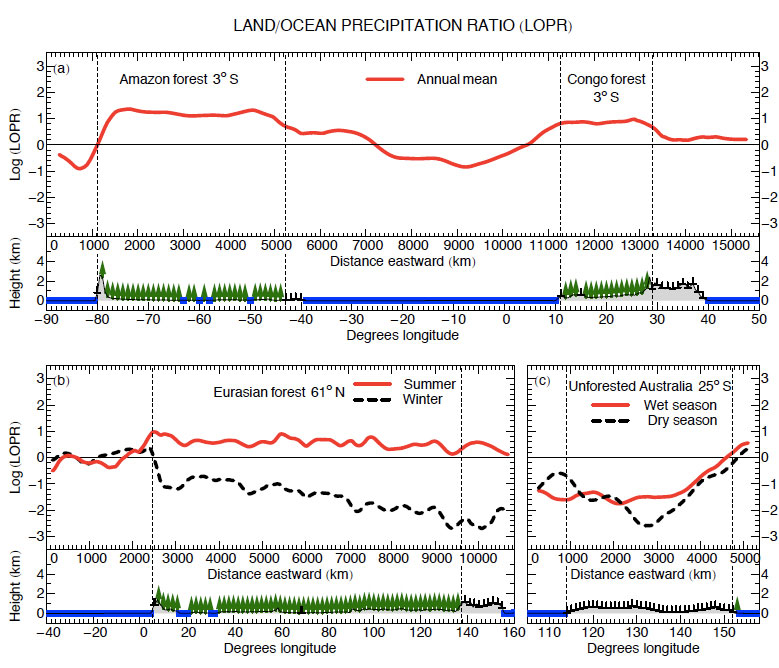
This figure shows the "tug-of-war" between the forest and the ocean for the right to become a predominant condensation zone. In Fig. a: on average the Amazon and Congo forests win this war: annual precipitation over forests is two to three times larger than the precipitation over the Atlantic Ocean at the same latitude. Note the logarithmic scale on the vertical axis: "1" means that the land/ocean precipitation ratio is equal to e = 2.718, "2" means it is equal to e2 ≈ 7.4; 0 means that this ratio is unity (equal precipitation on land and the ocean); "-1" means this ratio is 1/e ≈ 0.4; and so on. In Fig. b: the Eurasian biotic pump. In winter the forest sleeps, so the ocean wins, and all moisture remains over the ocean and precipitates there. In summer, when trees are active, moisture is taken from the ocean and distributed regularly over seven thousand kilometers. The forest wins! (compare the red and black lines) As a result, precipitation over the ocean in summer is lower than it is in winter, despite the temperature in summer is higher. Finally, in panel (c): an unforested Australia. One can often hear that Australia is so dry because it is situated in the descending branch of the Hadley cell. But this figure shows that such an interpretation does not hold. Both in wet and dry seasons precipitation over Australia is four to six times lower than over the ocean. There is no biotic pump there. Being unforested, oceanic moisture cannot penetrate to the Australian continent irrespective of how much moisture there is over the ocean; during the wet season it precipitates in the coastal zones causing floods. Gradually restoring natural forests in Australia from coast to interior will recover the hydrological cycle on the continent. Click to enlarge.


Mongabay: Have there been any significant changes to your biotic pump theory over the last couple years?

Victor Gorshkov and Anastassia Makarieva: The physical basis of the biotic pump consists in the statement that winds are driven mostly by condensation-induced pressure gradients rather than by temperature differences (such as warm air rises) as conventionally considered. As we judged from the first reactions to our work, this is the most difficult statement for the meteorological community to accept. Recently we concentrated our efforts on demonstrating the quantitative validity of the proposed mechanism of condensation-induced atmospheric dynamics. We have shown that it quantitatively explains hurricanes and tornadoes, having obtained from theory radial profiles of pressure and velocity that agree well with observations. On the other hand, we criticized some of the existing explanations of the same phenomena arguing that these contain physical errors. A full list of our publications concerning the biotic pump can be found here.

Mongabay: Have you seen wider acceptance in the scientific community for your theory?


Redwood forest of Russian Gulch State Park . Photo by: Rhett A. Butler.
Redwood forest of Russian Gulch State Park in California. Photo by: Rhett A. Butler
Victor Gorshkov and Anastassia Makarieva: Generally, judging from the increasing number of citations of our first biotic pump papers, our work is gradually gaining more attention. The biotic pump theory calls on the meteorological community to admit a possibility that an important atmospheric circulation driver has been overlooked. As long as one continues to ignore the role of condensation in driving winds, one will continue to ignore the real role of forests in the water cycle and climate. Given the deforestation threat, there is no time to lose. So we are undertaking all possible efforts to stimulate a constructive discussion of condensation dynamics by members of the meteorological community.

Still, the progress appears to be slow. In 2010 we submitted an overview of the theory to the journal ACPD, Atmospheric Chemistry and Physics Discussions that allows for an open discussion of submitted papers: Makarieva A.M., Gorshkov V.G., Sheil D., Nobre A.D., Li B.-L. (2010) Where do winds come from? A new theory on how water vapor condensation influences atmospheric pressure and dynamics. Atmospheric Chemistry and Physics Discussions, 10, 24015- 24052.

For six months the editors could not find reviewers willing to publicly evaluate our work. After we informed the wider scientific community of our situation, a leading NOAA hydrologist circulated our work among many of his colleagues-meteorologists. Only one of them considered the possibility of becoming a referee, and he strongly objected to our work. As we have always welcomed any criticism to be put forward openly regarding our work, we suggested that the editor invite the referee even though we knew in advance that he had a negative view of our work. After the negative review was posted, we replied to all the arguments. Since then the paper was suspended, it has now been in open review for over fifteen months and it's been twenty months since our submission. As any scientist will tell you, such extraordinary impediments and delays would discourage any researcher; they are disrupting the normal scientific process. But we remain hopeful that our efforts are not in vain.

Mongabay: Can you give an example of why the current understanding of condensation and precipitation is wrong?

Victor Gorshkov and Anastassia Makarieva: Our work was discussed rather widely on the web, sometimes with direct or indirect participation of leading meteorologists. These discussions revealed that the physics of condensation has not been given sufficient attention by the meteorological community, the result being that even some very basic issues remained unresolved and unclear to many. For example, a question that caused a lot of confusion was: if condensation occurs in the atmosphere and some vapor turns to liquid, will air pressure at the surface be affected near instantaneously or only after the raindrops have fallen to the ground? The latter is a common view caused by a fundamental misunderstanding of the concept of hydrostatic equilibrium.


Rainstorm over the Amazon. Photo by: Rhett A. Butler.
In hydrostatic equilibrium, air pressure at any height is equal to the weight of air in the atmospheric column above that height. Many meteorologists think that hydrostatic air pressure at the surface is equal to the weight of both air and all the liquid and solid bodies including the raindrops that are in the upper atmosphere. Had this been true, condensation in hydrostatic equilibrium could have never changed the surface pressure prior to precipitation fallout, because condensation of gas (vapor) into liquid does not change the total amount of matter. However, ideal gas pressure depends on the number of particles not their mass. The number of liquid drops is many orders of magnitude smaller than the number of gas molecules that have condensed into those drops. Therefore, condensation immediately lowers air pressure and disturbs the hydrostatic equilibrium. Recently a paper devoted to this question was published in a leading meteorological journal where, with use of numerical modeling, this conclusion was articulated. That a paper with such a basic conclusion has appeared only now—in the second decade of the Twenty First Century—demonstrates that the efforts to study the dynamic effects of condensation by the meteorological community are in their incipient stage.

In the meantime, practically all climate and weather phenomena where condensation and precipitation are involved are challenging modern meteorology. For example, the existing global circulation models do not adequately describe the water cycle in the Amazon, with the modeled moisture convergence being half the actual amounts estimated from the observed runoff values. It is widely recognized that despite the ever-improving observation facilities and the available computer power, there is no progress in predicting the intensity of tropical cyclones.

When analyzing how precipitation changes with time (e.g., in the Amazon or Congo regions) it is common to explore correlations with oceanic temperature anomalies. The conventional logic is that as the ocean becomes warmer, the warm air rises over the ocean and moisture precipitates there rather than over land, hence a drought occurs. However, such logic does not take into account that as the land becomes drier, it also warms significantly. It is unexplainable within the conventional paradigm why the warm air does not rise over the hot and dry land. All heat waves and droughts, like the one in European Russia in 2010 or the one in Texas in 2011, are associated with persistent descending air motion.

Neither are flooding events explained by the conventional paradigm. For example, of the two extreme floods that hit Thailand in 2011, the first one occurred early in the year during the dry season. Then the land is cooler, the ocean is warmer and winds blow from land to the ocean, so that the continent remains dry. In early 2011 the region was struck by an unusual cold wave, which caused this temperature gradient to become even more pronounced. According to the conventional paradigm, this should only strengthen dry conditions. In reality, however, a major flooding happened.

Evidence of this type, which is controversial with respect to the conventional paradigm, is mounting and the biotic pump concept gives a consistent physical explanation of how this should be interpreted. Rather than focusing on temperature gradients, which are often a consequence rather than cause of the circulation, one should investigate the conditions when condensation is likely to occur to predict changes in atmospheric circulation.

REGIONAL EXAMPLES OF THE BIOTIC PUMP

The Maya city of Tulum. Research is adding up that deforestation may have been a large factor in the decline of the Mayan civilization. Photo by: Rhett A. Butler.


Mongabay: Recent evidence has linked the decline and fall of the Maya civilization to deforestation leading to less precipitation. How could the biotic pump theory connect to this?

Victor Gorshkov and Anastassia Makarieva: This data, as well as the data on the Nazca civilization in Peru, are in agreement with the biotic pump concept. It is noteworthy that the Yucatan peninsula is a relatively small region with maximum distance from coast never exceeding a thousand kilometers. This means that even so close to the ocean, massive deforestation can cause a significant precipitation decline.

The proposed explanation (see article: Evidence mounts that Maya did themselves in through deforestation) based on a slight change in albedo after deforestation and a corresponding decrease in solar energy available for convection does not make sense to us (although as we understand this work has not yet been published so we could not read it in detail). The power of atmospheric circulation does not exceed around 1 percent of solar power. It is not limited by solar radiation, but by the flux of potential energy available for conversion to the kinetic energy. The conventional paradigm associates this potential energy with temperature-related buoyancy. That is, to put things simply, if you do not have a temperature difference, you do not have a circulation, all other things (including solar energy) being the same. We propose a different source of potential energy associated with water vapor removal from the gas phase: after the Mayan forests were destroyed, evaporation and condensation ceased to occur over the Yucatan peninsula (irrespective of how its albedo changed). The result was that the low pressure zone was no longer there and moist air ceased to come to the Maya from the ocean. Generally, the biotic pump theory calls us to re-analyze the historical evidence associated with land cover change and the changes in the precipitation regime.

Mongabay: How do you see deforestation in the Amazon as impacting regional precipitation?

Victor Gorshkov and Anastassia Makarieva: According to recent analyses, during 1973-2003 precipitation in the Amazon River basin was declining at a rate of 0.3 percent annually, which means a trend of about 10 percent for the entire period. This does not include the most recent devastating droughts of 2005 and 2010. In the meantime, deforestation in the basin has amounted to about 30 percent during the same period. Deforestation mostly disturbed southern and south-eastern parts of the basin, where the precipitation/evaporation is less than in the basin core. Assuming that the total biotic pump intensity is a function of the integral of local precipitation over the total forest-covered area, one can conclude that the decrease in precipitation intensity is of the same order of magnitude as the degree of biotic pump deterioration. As deforestation marches to the interior of the basin and affects the ever more productive forests with the most precipitation, the disruption of the water cycle in the basin will increase disproportionately.

Mongabay: How do you think widespread deforestation will effect the hydrological cycle of places like the Indonesian islands? Given their smaller size, do they need the biotic pump?


Devastated rainforest landscape in Borneo. Indonesia has one of the highest rates of deforestation worldwide. Photo by: Rhett A. Butler.
Victor Gorshkov and Anastassia Makarieva: The total area occupied by the Indonesian archipelago, including space between the islands, is quite significant. Open water space between the forest-covered islands can only slightly weaken the biotic pump of the Indonesian forests that likely determine the precipitation regime in the adjacent oceanic regions. Indeed, there is a relatively stable low pressure zone over Indonesia that causes the so-called Walker circulation: surface air moves from the high pressure region of the eastern Pacific ocean towards the low pressure zone over Indonesia. When this low pressure zone diminishes or erodes, the Walker circulation weakens and an El Niño results. When the Walker circulation is strong, we have a La Niña. These phenomena are well-known for their long-range impacts on the climate of the Americas.

The biotic pump theory helps us understand why there is a low pressure system in Indonesia (because of intense condensation associated with forest functioning). Thus deforestation in the region should lead to a weakening of the Walker circulation. While this pattern needs to be further explored, it is worth mentioning that while the period from 1950 to 1975 was largely dominated by La Niña's (strong Walker circulation), starting from the late 70s the frequency of La Niñas dropped. This is in agreement with the idea that Indonesian deforestation over the last 30 years could have modified the large-scale airflow.

Mongabay: Does the biotic pump theory apply to boreal forests, such as those in Russia, as well?

Victor Gorshkov and Anastassia Makarieva: Biotic pump of the boreal forest zone is fully responsible for atmospheric moisture transport from the (Atlantic) ocean over several thousand kilometers. Recent deforestation in European Russia is apparently disrupting this mechanism causing abnormal warming and droughts.

Mongabay: Does biotic pump theory modify our current understanding of global climate change?

Victor Gorshkov and Anastassia Makarieva: The widespread view is that global climate change is largely due to anthropogenic pollution of the global environment. The main anthropogenic pollutant is carbon dioxide, which is emitted by burning fossil fuels. CO2 is the second most important greenhouse substance in the atmosphere of Earth, therefore its accumulation in the atmosphere is believed to be the main cause of the observed warming and other climatic changes. The main proposed strategy to combat climate change is by reducing carbon emissions.


Temperate rainforest of Alaska. According to the biotic pump theory, both temperate and tropical forests play a similar role in precipitation patterns. Photo by: Rhett A. Butler.
However, the greenhouse effect on Earth is mostly determined by water vapor and clouds, i.e., by atmospheric moisture, which is the main greenhouse substance. The absorption interval of CO2 molecules covers less than 20 percent of the spectrum of thermal radiation of the Earth’s surface, while atmospheric moisture absorbs thermal radiation rather uniformly over the entire spectrum. Therefore, the impact of increasing CO2 concentrations on the greenhouse effect can be completely compensated by a relatively minor change in the hydrological cycle over land. Such climate stabilization can be performed by natural forests that control the hydrological cycle on land and the adjacent ocean, provided they are allowed to occupy a significant area. Conversely, destruction of forests leads to disruption of the hydrological cycle, which expectedly causes significant fluctuations of the magnitude of the global greenhouse effect, up to complete loss of climate stability and transition of Earth’s climate to a state incompatible with life.

Most modern climate researchers have grown up on computer models of climate and are used to believing in the model output. As illustrated by the discussion of our work, it is rarely appreciated that by artificially setting the needed numerical parameters it is possible to simulate a very broad range of climate scenarios, including those that will agree with observations of the past. The existence of simulations that mimic the past and present reality does not mean that the physics included in the models is correct or that the model can generate a trustworthy prediction.

What is more, modern climate modeling has been traditionally implemented by people with a technological background and little knowledge of ecosystem functioning. Such knowledge is generally poor, too. Thus, the ecological systems are "fed" into the models as a set of geophysical parameters, e.g., albedo, evaporation rate, surface roughness, amount of stored carbon etc. While the numeric values of these parameters are borrowed from reality, they do not represent the ecosystem functioning in very much the same manner as a colored high-resolution digital photo of a dead corpse does not represent a live human being. Without studying the principles of highly-organized functioning of ecological communities, including their genetically encoded ability to respond to environmental perturbations in a non-random compensatory way, the perspectives drawn from global circulation models with respect to the climatic effects of land cover change (e.g., statements like cutting all boreal forests will ease global warming) will continue to lack any resemblance to reality.

Quantitative analysis of ecological and biological variables is a very complicated task due to the complexity of living objects. Consider a flying canon and a flying bird that are both under gravity. A quantitative description of the former is straightforward, while to predict where and how the bird will fly from initial conditions is not feasible. This complexity of living systems and the number of surprises it implies for global environmental research has only recently begun to be gradually appreciated across a number of disciplines, from organismal energetics to soil biochemistry and climatology.

The biotic pump concept (and more generally the theory of the biotic regulation of the environment of which the former is a part) for the first time quantifies the stabilizing environmental function of natural ecosystems with respect to the hydrological cycle and pinpoints the physical mechanism that is responsible for this function. We must elevate the status of ecosystem conservation from a side issue in global environmental talks and treaties (that are exclusively focused on carbon) to an urgent high priority issue. We must also implement targeted research programs to study the stabilizing impact of natural ecosystems, to stimulate public discussion, and to raise people’s awareness of the real value of forests.

THE BIOTIC PUMP AND POLICY


Mongabay: What policy changes does the biotic theory suggest for governments worldwide?

Victor Gorshkov and Anastassia Makarieva: 1. The biotic pump theory shows that natural forests are indispensable if we want to have rainfall, and, consequently, agriculture on the land where we live. This scientific message has important economic implications. First of all, people and governments worldwide should realize that economic growth cannot occur at the expense of cutting forests either in one's own country or elsewhere. It is undermining the very pillars of our civilization’s existence. When water and food security are at stake, it is not possible for forest industries to focus on growth, just to increase the global production of wrapping and toilet paper. This should be the main topic of environmental campaigns.

There are important branches of human activities where economic growth is not possible: that is, for example, fisheries. Consumption of natural fish products is limited by the rate of their recovery in nature, which is achieved by the mechanism of international quotas. Lack of such regulations could result in transient economic growth, but would ultimately lead to collapse of the entire industry when the fish base is depleted. For a different reason, economic growth is equally not possible based on criminal activities like selling drugs or human organs. Were such activities encouraged, as are other economic activities, this could lead to transient "economic growth" but then to the physical collapse of the population. Where this is understood, people are taking measures against such activities.


Raw timber lines a port in Gabon. Photo by: Rhett A. Butler.
The case with the forestry industry is less akin to fishery but more akin to drug and human organ selling. Humanity needs a large territory of natural, intact, undisturbed forests to run the hydrological cycle on land. This strict environmental criterion is incompatible with the criterion of "sustainability" applied in modern forestry, when trees are in the best case cut at the rate at which they regrow and when the majority of trees are cut when they are 50 years of age. Conceptually, this could be compared to growing human beings for organs and killing them when they are, say, fifteen years of age. Such an "economic activity" could be "sustainable" and "profitable" for some, but one cannot expect civilization based on such "economics" to be stable and give birth to Shakespeares, Mozarts, Einsteins etc. Human beings grown for organs cannot live a normal human life, they cannot work creatively or develop. Likewise, trees grown for timber cannot perform their environmental function and stabilize the climate: only a natural ecosystem with a full suite of all the necessary biological species can do this.

In other words, society must urgently take the course of gradually shrinking the forestry industry. Destruction of natural forest ecosystems is a crime against humanity and will be increasingly perceived as such as new knowledge accumulates, environmental literacy increases, and ethical standards change accordingly. Such radical changes have happened in human history: slavery, once perceived as economically prudent and otherwise "normal," was abolished.

We must emphasize that the responsibility for the current situation, where natural forests are being destroyed, rests on all the people of Earth rather than with the forestry industry alone. We are all consumers of timber products. Because many livelihoods depend directly on forest exploitation today, large-scale programs are needed to gradually change the professional occupation of these people, to slow down the forestry industry and ultimately radically minimize their economic scope. In the meantime, government grants should support research aimed at finding new ways of wrapping things without paper or any other tree-derived product.

2. Governments should remember that natural forest recovery takes many decades and even hundreds of years, before the biotic pump acquires its full power. It is much easier to protect forests than to re-grow them. For example, tree planting in China has nothing to do with forest restoration; it is doomed to fail. To completely restore a degraded ecological communities is as difficult as cloning a mammoth in an elephant egg cell. Ecosystem medicine and health care have not yet developed as a science. In the meantime, we should urgently conserve all that we have now.

3. Efforts should be coordinated to protect both boreal and tropical forests. In countries with strong democracy society is more efficient at achieving nature conservation goals. It becomes possible for society to mitigate the negative environmental impact of even large-scale development projects aimed at resource extraction from yet widening areas. For example, in Canada the implementation of Plan Nord aimed at a massive intensification of resource extraction in Quebec was forced by people to include conservation of 50 percent of the affected territory, including a vast area with boreal forests, in an undisturbed state. This positive experience should be studied and shared among nations.

4. In an overpopulated world forests and the environment cannot be saved. Family planning is the main strategic tool to conserve forests and restore environmental sustainability.


Related articles

Revolutionary new theory overturns modern meteorology with claim that forests move rain

(04/01/2009) Two Russian scientists, Victor Gorshkov and Anastassia Makarieva of the St. Petersburg Nuclear Physics, have published a revolutionary theory that turns modern meteorology on its head, positing that forests—and their capacity for condensation—are actually the main driver of winds rather than temperature. While this model has widespread implications for numerous sciences, none of them are larger than the importance of conserving forests, which are shown to be crucial to 'pumping' precipitation from one place to another. The theory explains, among other mysteries, why deforestation around coastal regions tends to lead to drying in the interior.


Bad feedback loop: climate change diminishing Canadian forest's carbon sink

(01/30/2012) Climate change, in the form of rising temperatures and less precipitation, is shrinking the carbon sink of western Canada's forest, according to a new study released today in the Proceedings of the National Academy of Sciences (PNAS). Tree mortality and a general loss of biomass has cut the carbon storage capacity of Canada's boreal forests by around 7.28 million tons of carbon annually, equal to nearly 4 percent of Canada's total yearly carbon emissions.


Droughts could push parts of Africa back into famine

(12/19/2011) Drought and erratic rains could lead to further food scarcities in Africa warns the United Nations World Food Program (WFP). The WFP singles out South Sudan, the world's newest nation, and Niger as nations of particular concern. Earlier this year famine killed scores of people, including an estimated 30,000 children, in Somalia.


Is the Russian Forest Code a warning for Brazil?

(12/19/2011) Brazil, which last week moved to reform its Forest Code, may find lessons in Russia's revision of its forest law in 2007, say a pair of Russian scientists. The Brazilian Senate last week passed a bill that would relax some of forest provisions imposed on landowners. Environmentalists blasted the move, arguing that the new Forest Code — provided it is not vetoed by Brazilian President Dilma Rousseff next year — could undermine the country's progress in reducing deforestation.


Evidence mounts that Maya did themselves in through deforestation

(12/08/2011) Researchers have garnered further evidence for a smoking gun behind the fall of the great Maya civilization: deforestation. At the American Geophysical Union (AGU) conference, climatologist Ben Cook presented recent research showing how the destruction of rainforests by the Mayan ultimately led to declines in precipitation and possibly civilization-rocking droughts. While the idea that the Maya may have committed ecological-suicide through deforestation has been widely discussed, including in Jared Diamond's popular book Collapse, Cook's findings add greater weight to the theory.


Converting rainforest to cropland in Africa reduces rainfall

(09/19/2011) Converting West African rainforests into cropland reduces rainforest in adjacent forest areas, reports research published in Geophysical Research Letters.


Chart: US suffers record drought

(08/01/2011) An exceptional drought is still scorching major parts of Texas, New Mexico, Oklahoma, and Louisiana. A new report from the National Drought Mitigation Center finds that over July, nearly 12 percent of the US saw exceptional drought conditions, the highest record since monitoring began a dozen years. Exceptional drought is the worst possible on a 5-scale drought scale.


An undamaged Amazon produces its own clouds and rain

(09/21/2010) Researchers recently traveled to the remote Brazilian Amazon to investigate how clouds are formed and rain falls in an atmosphere unburdened by human-caused pollution. Studying the atmospheric aerosol particles, which impact cloud formation and particles, above a pristine forests, researchers discovered that when left alone the Amazon acts as its own 'bioreactor': clouds and precipitation are produced by the abundance of plant materials.


World failing on every environmental issue: an op-ed for Earth Day

(04/22/2010) The biodiversity crisis, the climate crisis, the deforestation crisis: we are living in an age when environmental issues have moved from regional problems to global ones. A generation or two before ours and one might speak of saving the beauty of Northern California; conserving a single species—say the white rhino—from extinction; or preserving an ecological region like the Amazon. That was a different age. Today we speak of preserving world biodiversity, of saving the 'lungs of the planet', of mitigating global climate change. No longer are humans over-reaching in just one region, but we are overreaching the whole planet, stretching ecological systems to a breaking point. While we are aware of the issues that threaten the well-being of life on this planet, including our own, how are we progressing on solutions?


Drought crippling southwest China, millions without drinking water

(03/22/2010) Over 50 million people are affected by a severe drought in southwest China, according to Xinhua, the nation's state media. The lack of rain and unseasonably high temperatures has also left 16 million people without easy access to drinking water.


Healthy coral reefs produce clouds and precipitation

(03/03/2010) Twenty years of research has led Dr. Graham Jones of Australia's Southern Cross University to discover a startling connection between coral reefs and coastal precipitation. According to Jones, a substance produced by thriving coral reefs seed clouds leading to precipitation in a long-standing natural process that is coming under threat due to climate change.


Decline in fog threatens California's iconic redwood ecosystems

(02/15/2010) A surprising new study finds that during the past century the frequency of fog along California's coast has declined by approximately three hours a day. Published in the Proceedings of the National Academy of Sciences the researchers are concerned that this decrease in fog threatens California's giant redwoods and the unique ecosystem they inhabit.


Air pollution in China reduces rainfall

(08/31/2009) Air pollution in eastern China over the past half century has reduced rainfall and exacerbated the risk of drought and crop failures, reports a study published in the Journal of Geophysical Research.


Massive deforestation in the past decreased rainfall in Asia

(06/25/2009) Between 1700 and 1850 forest cover in India and China plummeted, falling from 40-50 percent of land area to 5-10 percent. Forests were cut for agricultural use across Southeast Asia to feed a growing population, but the changes from forests to crops had unforeseen consequences. A new study published in the Proceedings of the National Academy of Sciences links this deforestation across Southeast Asia with changes in the Asian Monsoon, including significantly decreased rainfall.


CITATION:
Jeremy Hance
mongabay.com (February 01, 2012). New meteorological theory argues that the world's forests are rainmakers. http://news.mongabay.com/2012/0201-hance_interview_bioticpump.html


Tags:
precipitation weather deforestation forests rainforests ecosystem services ecological services Science environmental services Russia indonesia brazil south america asia southeast asia latin america Amazon Deforestation Amazon rainforest Climate Modeling climate change climate science strange tropical forests rainforest destruction rainforest conservation impact of climate change impacts of climate change environment Rainforest deforestation amazon amazon conservation amazon destruction bold and dangerous ideas that may save the world carbon emissions carbon sequestration carbon dioxide ecology global warming mitigation governance green jeremy hance interviews interview plantations rainforest temperatures temperate forests threats to the amazon threats to rainforests threats to the rainforest


quinta-feira, 26 de janeiro de 2012

In Brazil, Fears of a Slide Back for Amazon Protection

The New York TIMES


SÃO PAULO, Brazil — Brazil has made great strides in recent years in slowing Amazon deforestation and showing the world it was serious about protecting the mammoth rain forest. 

The rate of deforestation fell by 80 percent over the past six years, as the government carved out about 150 million acres for conservation — an area roughly the size of France — and used police raids and other tactics to crack down on illegal deforesters, according to both environmentalists and the government. Brazil’s former environment minister, Marina Silva, became an internationally respected defender of the Amazon. She ran for president in 2010 on the Green Party ticket and won 19.4 percent of the votes.

But since Dilma Rousseff was elected president in late 2010, there have been signs of a shift in the government’s attitude toward the Amazon. A provisional measure now allows the
president to decrease the lands already created for conservation. The government is granting more flexibility for large infrastructure projects during the environmental licensing process. And a proposal would give Brazil’s Congress veto power over the recognition of indigenous territories.

“What is happening in Brazil is the biggest backsliding that we could ever imagine with regards to environmental policies,” said Ms. Silva, who now devotes her time to environmental advocacy. 


Now, a bill seeking to overhaul the 47-year-old Forest Code, a central piece of environmental legislation, is the most serious test yet of Ms. Rousseff’s stance on the environment. 

The debate over the law has revealed the stark disconnect between a population that is increasingly supportive of conserving the Amazon and a Congress in which agricultural interests in the country’s rural north and northeast still hold sway. The furor comes as Brazil is set to hold a United Nations conference on sustainable development in Rio de Janeiro in June. 

Before taking office last January, Ms. Rousseff promised to veto any revision of the Forest Code that granted amnesty to landowners who had previously deforested illegally. Then her government negotiated a version of the code, approved by the Senate in December, that would give amnesty to farmers who broke the law before 2008 — provided they agreed to plant new trees. The House is expected to debate the legislation once again in March, with Ms. Rousseff holding final veto power. 

The fight over the Forest Code has stoked the age-old struggle over development versus conservation in Brazil, a country that bears the weight of international pressure to protect the Amazon from deforestation because its sheer scale could affect global climatic conditions. Ms. Rousseff, a former energy minister, has so far flashed a more pro- development stance, environmentalists say, shifting the balance from the administration of her predecessor, Luiz Inácio Lula da Silva, who appointed Ms. Silva.

Agriculture represents 22 percent of Brazil’s gross domestic product. The so-called ruralists in Congress say that the old code is holding back Brazil’s agricultural potential and that it needs updating to allow more land to be opened up to production. Environmentalists counter that there is already enough land available to double production and that the proposed changes would open the door to a surge in deforestation.

Last May, the House approved a more sweeping amnesty for those who had illegally deforested, outraging environmentalists and scientists. It did not help that the deputies refused to receive a group of respected Brazilian scientists that issued a report condemning the changes. 

“In the House, there was very little consultation with scientists,” said Carlos Nobre, a scientist at Brazil’s National Institute for Space Research who specializes in climate issues. Still, he said, scientists “waited too long to realize that the House wanted to radically change the Forest Code, creating a broad and unrestricted license to deforest.” 

Ms. Silva, who was raised in the Amazon, resigned in 2008 after a backlash by rural governors to restrictions on illegal deforestation she had put in place. But she left what environmentalists consider an effective policy to control Amazon deforestation. Among other tactics, Mr. da Silva’s government used satellite images to home in on deforesters, organized police raids and blacklisted the worst offenders. 

“The ruralists have pushed so much to change the Forest Code because the government actually started enforcing it under Marina Silva,” said Stephan Schwartzman, director for tropical forest policy at the Environmental Defense Fund in Washington. 

The vote in the House showed how heavily represented the less developed north and northeast are in Brazil’s Congress, a relic of the military dictatorship

“The skewed proportional representation in Brazil has shown that the environmentalists have much less power in Congress than they have in public opinion,” said Gilberto Câmara, director of the National Institute for Space Research, which monitors Amazon deforestation. 


Days after the House vote last May, a poll by Datafolha showed that 85 percent of Brazilians believed the reformed code should prioritize forests and rivers, even if it came at the expense of agricultural production. 

After weeks of debate, the bill the Senate approved in December was somewhat more palatable to environmentalists. Rather than outright amnesty for past illegal deforestation, the Senate version lets farmers replant to avoid fines. The legislation now goes back to the House. 

“We have to reconcile the generation of income with sustainability,” Izabella Teixeira, the current environment minister, said after the vote. 

For Marcos Jank, president of the Brazilian Sugarcane Industry Association, a major reason to change the code is to legalize countless Amazon properties lacking land titles that have complicated the tracking of illegal activity. “When you have a Forest Code that legalizes land titles, then that has the effect of reducing deforestation, not increasing it,” he said. 

The government claims the code will reforest about 60 million acres, much of it in the Amazon, which the Environment Ministry calls “the largest reforestation program in the world.” But who will pay for all those new trees? And will the government enforce the replanting requirements? 

“The small producers don’t have the money to replant,” Mr. Jank said. “You need to develop programs to help them.” 

There are also questions about the size of lands being exempted from the legal requirement to preserve 80 percent of the trees in Amazon properties. The new law would exempt “small” properties of up to four “fiscal modules,” which in the Amazon are almost 1,000 acres combined. 

“That is a large property in any part of the world,” Mr. Nobre said. “I see great risk here if this definition is maintained.” 

Despite the concerns, there is no denying that deforestation in Brazil, driven largely by clearing land for inefficient cattle grazing, has been on a downward trend. Beyond that, a new generation of satellites over the next two years will give Brazil access to images from seven satellites, up from the current two.


If people abide by the law — a big if — Mr. Câmara and other scientists are predicting that the Brazilian Amazon has a chance by 2020 to become a “carbon sink,” in which the amount of forest being replanted is larger than the amount being deforested. 

“President Rousseff is extremely aware of this,” Mr. Câmara said. “When I told her, she almost fell off her chair.” 

But to make that happen, “there has to be very strong government financing and support for people to recover the forest,” he said.

sexta-feira, 2 de dezembro de 2011

Protecting Brazil's forests

 
Fiddling while the Amazon burns

Keeping the worlds biggest forest standing depends on greens, Amerindians and enlightened farmers working together if lawmakers let them

From the Economist: Dec 3rd 2011 | JACI-PARANÁ, RONDÔNIA | from the print edition

DRIVE out of Porto Velho, the capital of the Amazonian state of Rondônia, and you see the trouble the worlds largest forest is in. Lorry after lorry trundles by laden with logs; more logs lie by the road, to be collected by smugglers who dumped them on the rumor of a (rare) road check. Charred tree-stumps show where ranchers burned what the loggers left behind; a few cattle roam sparsely through the scrubby fields. In places the acid subsoil shows through, sandy and bone-pale. Seen from above, the roads look like hatchet blows, with dirt tracks radiating outward like thinner wounds. The picture is reproduced across the Amazons arc of deforestation (see map).


The Brazilian Amazon is now home to 24m people, many of them settlers who trekked those roads in the 1960s and 1970s, lured by a government promise that those who farmed unproductive land could keep it. Chaotic or corrupt land registries left some without secure title. Rubber-tappers, loggers, miners and charcoal-burners came too. The most recent arrivals are 20,000 construction workers building dams on the Madeira and Xingu rivers to provide electricity to Brazils populous south. They have attracted some 80,000 camp followers, many of whom squat on supposedly protected land.

The population of Jaci-Paraná, the nearest town to the Jirau dam being built on the Madeira, has risen from 3,500 to 21,000 in a decade but it still has just four police. Prostitutes and drug-dealers do well. On payday, says Maria Pereira, a teacher, busloads of construction workers hit town to drink and fight. Knife-killings are common. When the dam is finished, many of the new residents will move on. Behind them, a bit more of the Amazon will be gone.

Brazils government no longer encourages cutting down the forest. Nearly half of it now lies within indigenous reserves, or state and federal parks where most logging is banned. Private landowners must abide by the Forest Code, a law dating from 1965 that requires them to leave the forest standing on part of their farms (four-fifths in the Amazon, less elsewhere), and in particular around the sources and banks of rivers, and on hillsides.

But the code is routinely flouted. Less than 1% of the fines levied for failing to observe it are ever paid, because of uncertain ownership and poor enforcement. The Suruí, an Amerindian people, recently mapped its territory in Rondônia, on paper strictly protected. The tribe was shocked to find that 7% had been cleared.

In Brasília 2,000km (1,250 miles) and a world away, politicians are haggling over laws that will affect the fate of the forest. Some legislators are pushing a bill that would give Congress, rather than the president, the power to create new reserves. That would probably mean fewer new ones a blow for the forest, says Ivaneide Bandeira of Kanindé, a non-profit group in Rondônia. Indigenous people protect the forest better than anyone else, she says.

The Senate is poised to vote on a new version of the Forest Code, already approved by the lower house. The president, Dilma Rousseff, wants a final version on her desk before Christmas. Everyone agrees that change is needed. The share of private land that must be set aside has risen since 1965 and farmers who were once in compliance but omitted to update their paperwork can end up lumped in with lawbreakers. Kátia Abreu, a senator who is the president of the main farm lobby, says farmers find such uncertainty deeply worrying. Environmentalists dislike it too, since it encourages loggers and land-grabbers by fuelling disrespect for the law.

But the consensus has gone no further. The farm lobby wanted all past land clearance regularized, arguing that if farmers had to replant trees, crop output would fall, food prices soar and poor Brazilians go hungry. Greens countered that an amnesty would fuel future deforestation. So far, at least, the farm lobby is winning. The current draft allows farmers to dodge fines for illegal logging and postpone their obligation to replant by simply declaring that their violations were committed before July 2008 and by enrolling in a vague and leisurely environmental recovery programme, to be run by individual states.

This is an amnesty in all but name, says Maria Cecília Brito, the head of WWF-Brazil, a conservation group. Without safeguards, states will be able to postpone forever the requirement to act. After several years in which the annual rate of deforestation fell, this year it has risen, possibly because landowners think the new code will let them get away with it. Law-abiding farmers are outraged. When Darci Ferrarin bought a large farm in Mato Grosso in 1998, he knew that its riverbanks had been illegally cleared. He paid to replant. Those who deforested illegally should go to jail, declares his son, Darci Junior.

The only promising aspect of the new code, thinks Roberto Smeraldi of Amazônia Brasileira, a green NGO, is that it offers benefits such as subsidized loans to landowners who have always stuck by the rules, or who are reforesting faster than the law demands. But he laments the missed opportunity for a grand bargain to align opposed interests. A cap-and-trade system like those used to limit industrial pollution in rivers could have helped farmers short of set-aside to comply with the law by paying neighbors with more than the legal minimum to maintain it. That would both have spared farmers from costly replanting and cut future deforestation by making standing forests financially valuable.

Ms Rousseff promises to veto any amnesty for illegal deforesters. But the fig leaf of the environmental recovery programme may give her scope to temporize, and with a heavy legislative schedule she may be tempted to do so. If she does, the Amazons best hope will lie with the enlightened farmers and indigenous tribes who care for their land better than the state is willing to.

For Mr Ferrarin, the way to halt deforestation is to use existing farmland better. Almost half his farm of 13,350 hectares (33,000 acres) is set aside as forest; the rest supports 3,000 cattle as well as soya and several other crops, farmed in rotation. Innovative no-till methods cut carbon emissions, fertilizer use and labor. The Ferrarins run workshops to teach other farmers about such integrated farming techniques. Mr Ferrarins daughter, Valkiria, runs a cattle-breeding programme, with an on-site IVF clinic where embryos from prize animals are implanted in surrogates. A productive farm can support an extended family for several generations, he says.

Cassio Carvalho do Vals father settled in Redenção in Pará in 1959. It was then virgin rainforest: the last 150km of the journey was by donkey, carrying dried meat, rice and beans. Nine-tenths of the 300,000 hectares he was granted has since been sold, but the farm is still vast (the average farm in the United States comprises around 160 hectares), and unproductive, with just one cow per hectare of pasture. But his son has started to fatten his cows with grain and plans to try integrated farming. Its the dream of every crop farmer to be a rancher, he says with a laugh. Its so much easier. But he thinks he needs to keep up with the times.

The Suruí set an example

Some of Brazils indigenous peoples are redoubling their efforts to protect the standing forest. The 1,300 Suruí have moved their 25 villages to the borders of their territory to get early warning of incursions. With help from Kanindé and others, since 2005 they have started to reforest where intruders have cleared. To the inexperienced eye, the new trees already look ancient (though to the Suruí the sparser cover is still obvious). Next year the tribe will host other indigenous peoples who want to repair deforestation on their own lands. They hope to start teaching non-indigenous folk, too.

The Suruí are the first Brazilian tribal people to set up a REDD project, an international aid scheme to prevent deforestation. Up to 10% of the income generated will go to local non-Indians, to show them that standing forest can create jobs and income. We are not saying, don’t use the forest, explains the chief, Almir Narayamoga Suruí. We are saying you should think about the medium and long term when you decide how to use it. That will be easier if the politicians approve a Forest Code that looks to the future, not the past and then provide the means to enforce it.

from the print edition | The Americas

sexta-feira, 4 de novembro de 2011

Google to Host Terabytes of Open-Source Science Data

Einsteingoogle Sources at Google have disclosed that the humble domain, http://research.google.com, will soon provide a home for terabytes of open-source scientific datasets. The storage will be free to scientists and access to the data will be free for all. The project, known as Palimpsest and first previewed to the scientific community at the Science Foo camp at the Googleplex last August, missed its original launch date this week, but will debut soon.
Building on the company’s acquisition of the data visualization technology, Trendalyzer, from the oft-lauded, TED presenting Gapminder team, Google will also be offering algorithms for the examination and probing of the information. The new site will have YouTube-style annotating and commenting features.
The storage would fill a major need for scientists who want to openly share their data, and would allow citizen scientists access to an unprecedented amount of data to explore. For example, two planned datasets are all 120 terabytes of Hubble Space Telescope data and the images from the Archimedes Palimpsest, the 10th century manuscript that inspired the Google dataset storage project.
UPDATE (12:01pm): Attila Csordas of Pimm has a lot more details on the project, including a set of slides that Jon Trowbridge of Google gave at a presentation in Paris last year. WIRED’s own Thomas Goetz also mentioned the project in his fantastic piece of freeing dark data.

One major issue with science’s huge datasets is how to get them to
Google. In this post by a SciFoo attendee over at business|bytes|genes|molecules, the collection plan was described:
(Google people) are providing a 3TB drive array (Linux RAID5). The array is provided in “suitcase” and shipped to anyone who wants to send they data to Google. Anyone interested gives
Google the file tree, and they SLURP the data off the drive. I believe they can extend this to a larger array (my memory says 20TB).
You can check out more details on why hard drives are the preferred distribution method at Pimm. And we hear that Google is hunting for cool datasets, so if you have one, it might pay to get in touch with them.

Freeing the Dark Data of Failed Scientific Experiments

By Thomas Goetz Email 09.25.07
It's Time to Free the Dark Data of Failed Scientific Experiments
Photo: Mauricio Alejo 
 
In 1981, the New England Journal of Medicine published a Harvard study that showed an unexpected link between drinking coffee and pancreatic cancer. As it happened, researchers were anticipating a connection between alcohol or tobacco and cancer. But according to the survey of several hundred patients, booze and cigarettes didn't seem to increase your risk. Then came a surprise: An incidental survey question suggested that coffee did increase the chances of pancreatic cancer. So that's what got published.

Those positive results, alas, were entirely anomalous; 20 years of follow-up research showed the coffee-cancer connection to be bunk. Nonetheless, it's a textbook example of so-called publication bias, where science gets skewed because only positive correlations see the light of day. After all, the surprising findings are what makes the news (and careers).

So what happens to all the research that doesn't yield a dramatic outcome — or, worse, the opposite of what researchers had hoped? It ends up stuffed in some lab drawer. The result is a vast body of squandered knowledge that represents a waste of resources and a drag on scientific progress. This information — call it dark data — must be set free.

For the past couple of years, there's been much talk about open access, the idea that more scientific publications should be freely available — not locked behind firewalls and subscriptions. Thanks to the Public Library of Science (PLoS) and other organizations, that notion is making headway. Liberating dark data takes this ethos one step further. It also makes many scientists deeply uncomfortable, because it calls for them to reveal their "failures." But in this data-intensive age, those apparent dead ends could be more important than the breakthroughs. After all, some of today's most compelling research efforts aren't one-off studies that eke out statistically significant results, they're meta-studies — studies of studies — that crunch data from dozens of sources, producing results that are much more likely to be true. What's more, your dead end may be another scientist's missing link, the elusive chunk of data they needed. Freeing up dark data could represent one of the biggest boons to research in decades, fueling advances in genetics, neuroscience, and biotech.

So why doesn't it happen? In part, it's a logistics problem: Advocating the release of dark data is one thing, but it's quite another to actually collect it, juggling different formats and standards. And, of course, there's the issue of storage. These days, an astronomical study of quasars or an ambitious bioinformatics project can generate several terabytes of data. Few have the capacity to store that, let alone analyze it.

Google, among others, is lending a hand with its Palimpsest project, offering to store and share monster-size data sets (making the data searchable isn't a part of the effort). As storage costs drop, similar data banks will emerge, along with format standards, and it should become ever easier to share results, good or bad.

Technology is actually the simple part. The tougher problem lies in the culture of science. More and more, research is funded by commercial entities, which deem any results proprietary. And even among fair-minded academics, the pressures of time, tender, and tenure can make openness an afterthought. If their research is successful, many academics guard their data like Gollum, wringing all the publication opportunities they can out of it over years. If the research doesn't pan out, there's a strong incentive to move on, ASAP, and a disincentive to linger in eddies that may not advance one's job prospects.
There are some islands of innovation. Since 2002, the Journal of Negative Results in Biomedicine has offered a peer-reviewed home to results that go negative or against the grain. Earlier this year, the journal Nature started Nature Precedings, a Web-based forum for prepublication research and unpublished manuscripts in biomedicine, chemistry, and the earth sciences. At Drexel University, chemist Jean-Claude Bradley practices "open notebook" science — chronicling his lab's work and sharing data via blog and wiki. And PLoS is planning an open repository for research and data that is other wise abandoned.

These are great first steps. But freeing dark data should be the norm, not the exception. Once the storage and format problems are solved, scientists will need easy ways to search and retrieve each other's data. (And there should be a simple way, perhaps via metadata, to make sure that work is always duly cited and acknowledged by others.) Congress should mandate that all federally funded research be disseminated, whatever the results.

Getting science comfortable with exposing its dark data is really just the beginning. Once you start looking for it, dark data is everywhere: It's locked away in out-of-print books and orphaned art, the stuff that Creative Commons and Google Book Search have been bringing to light. Speaking of which: Hey, Google! Know all those research projects your employees do that the company will never green-light? How about letting the rest of the world take a crack at them?

Deputy editor Thomas Goetz (thomas@wired.com) wrote about DNA diagnostics in issue 15.08.

The Thirteen Mindfulness Trainings


The Thirteen Mindfulness Trainings form the moral guidelines to develop harmony in any simple community. One of the essential elements of the Mindfulness Trainings is that they are directly applied in our daily lives. Every moment of our lives gives us the chance to put them into practice.
The idea is to recite the Mindfulness Trainings regularly so that we can review our behaviour and observe where we have not lived up to our aspirations. It is important that we observe rather than judge ourselves, so that gradually, without resistance, our lives become imbued with the qualities they represent.

Understanding (prajna), concentration (samadhi) and Mindfulness Trainings or ethics (sila) are the threefold trainings that the Buddha passed on to his lay students. The practice of each of these trainings is equally important.

The encounter between Eastern philosophies and the West is bringing us something very exciting, very important. When Buddhism enters one country, that country always acquires a new form of Buddhism. The merge result must be suitable, appropriate to the psychology and the cul ture of the society that it serves.

The Thirteen Mindfulness Trainings comes from different sources. The last part of them (5) comes directly from the Five Precepts followed by all the Tibetan Buddhist schools (Sila). The first eight comes from the Tiep Hien Order founded in Vietnam during the war and which came from the Zen School of Lin Chi.

Tiep and Hien are Vietnamese words of Chinese origin. I would like to explain the meaning of these words, because understanding them helps in understanding the spirit of the Trainings.

Tiep means “to be in touch.” First of all, to be in touch with oneself in order to find out the source of wisdom, understanding, and compassion in each of us. Being in touch with oneself is the meaning of medi tation, to be aware of what is going on in your body, in your feelings, in your mind. That is the first mean ing of Tiep.

Tiep
also means to be in touch with Buddhas and Bodhisattvas, the enlightened people in whom full understanding and compassion are tangible and ef fective. Being in touch with oneself means being in touch with this source of wisdom and compassion.

Hien means “the present time.” We have to be in the present time, because only the present is real, only in the present moment can we be alive. We do not practice for the sake of the future, to be reborn in a paradise, but to be peace, to be compassion, to be joy right now.

The First Mindfulness Training: Openness

Aware of the suffering created by fanaticism and intolerance, I am determined not to be idolatrous about or bound to any doctrine, theory or ideology, even Buddhist ones. Buddhist teachings are guiding means to help me learn to look deeply and to develop my understanding and compassion. They are not doctrines to fight, kill or die for.

The Second Mindfulness Training: Non-attachment to Views

Aware of the suffering created by attachment to views and wrong perceptions, I am determined to avoid being narrow-minded and bound to present views. I will learn and practise non-attachment from views in order to be open to others’ insights and experiences. I am aware that the knowledge I presently possess is always changing and not an absolute truth. Truth is found in life and I will observe life within and around me in every moment, ready to learn throughout my life.

The Third Mindfulness Training: Freedom of Thought

Aware of the suffering brought about when I impose my views on others, I am committed not to force others, even my children, by any means whatsoever, to adopt my views. I will respect the right of others to be different and to choose what to believe and how to decide.

The Fourth Mindfulness Training: Awareness of Suffering

Aware that looking deeply at the nature of suffering can help me develop compassion and find ways out of suffering, I am determined not to avoid or close my eyes before suffering. I am determined to be with those who suffer, so I can understand their situation deeply and help them transform their suffering into compassion, peace and joy.

The Fifth Mindfulness Training: Living Simply

Aware that true happiness is rooted in peace, solidarity, freedom and compassion, and not in wealth or fame, I am determined not to take as the aim of my life fame, profit, wealth, or sensual pleasure. I am committed to living simply and sharing my time, energy and material resources with those around me in need, including my blood and spiritual family, my friends, my ancestors and my descendents.

The Sixth Mindfulness Training: Dealing with Anger

Aware that anger blocks communication and creates suffering, I am determined to take care of the energy of anger when it arises and to recognize and transform the seeds of anger that lie deep in my consciousness. When anger comes up, I am determined not to do or say anything, but to find the best way to ease my anger. I will learn to look with the eyes of compassion on those I think are the cause of my anger.

The Seventh Mindfulness Training: Dwelling Happily in the Present Moment

Aware that life is available only in the present moment and that it is possible to live happily in the here and now, I am committed to training myself to live deeply each moment of daily life. I will try not to lose myself in dispersion or be carried away by regrets about the past, worries about the future, or cravings, anger or jealousy in the present. I will practise mindful breathing to come back to what is happening in the present moment. I am determined to learn the art of mindful living by touching the wondrous, refreshing and healing elements that are inside and around me, and by nourishing seeds of joy, peace, love and understanding in myself, thus facilitating the work of transformation and healing in my consciousness.

The Eighth Mindfulness Training: Communication and Reconciliation

Aware that lack of communication always brings separation and suffering, I will make every effort to keep communications open and to reconcile and resolve all conflicts, however small. Aware of the suffering caused by unmindful speech and the inability to listen to others, I am committed to cultivating loving speech and deep listening in order to bring joy and happiness to others and relieve others from their suffering.

The Ninth Mindfulness Training: Truthful Speech

Aware that words can create suffering or happiness, I am committed speak truthfully and constructively, using only words that inspire hope and confidence. I am determined not to say untruthful things for the sake of personal interest or to impress people, nor to utter words that might cause division or hatred. I will not spread news that I do not know to be certain nor criticize or condemn things of which I am not sure.

It is important to remember the four faults by the word:
  • lying.
  • pronouncing offensive words (hurtful speech).
  • uttering words that can cause division between two or more people by talking negatively of some of them, spread rumors, or sowing doubts. We have to be careful not to increase discord between people but to make all efforts to reconcile and resolve all conflicts, however small.
  • indulging in idle chatter. We must abstain of any kind of unmindful speech; spreading news we do not know to be certain; criticize or condemn people.
Our speech must embody mindfulness and we must be completely aware and responsible while pronouncing words.
Try making your words wiser than the silence that has been broken.
The Tenth Mindfulness Training: Reverence for Life

I am committed to abstain from doing harm to any sensitive beings. This commitment implies the determination to respect the life of all beings, not only human beings but also all animals and plants, regardless of their size; and an increasing awareness of the sanctity of life. Moreover it means more than a respect for the sacredness of life since it means a commitment to neither harm nor offend anyone under any circumstances and to promote peace and peace education.

The Eleventh Mindfulness Training: Respect and Generosity

I am committed to abstaining from taking what has not been given to me. This commitment implies the respect for other beings’ property. It not only implies not to steal, but encourages us to cultivate the attitude of not to demand or claim what we wish, but to learn ways to work for the benefit of people, animals and plants, practicing generosity, sharing our time, energy and resources with those in need, and to patiently wait to receive the results of our good actions.

The Twelfth Mindfulness Training: Correct use of our Senses

I am committed to abstain from the wrong use of my senses. This commitment implies contemplating our body as a temple that we take care of and cultivate for spiritual growth. What is advised here is to abstain from the disorderly use of the body, sexuality and body sensations, avoiding falling into gluttony, lust, incest and all kinds of disorders produced by inadequate sensory behavior.

The Thirteenth Mindfulness Training: Mindful Consumption

Aware of the suffering caused by unmindful consumption, I am committed to abstain from consuming items that cloud or blur the mind. It not only implies to abstain from alcohol and intoxicating drugs but to take care of the quality of information that we are consuming through all our senses, what are we reading, what we are seeing, who we are joining. We are aware that everything we consume will feed our mind and the collective mind of our family and society.

quarta-feira, 12 de outubro de 2011

Entering the anthropocene: ‘Geonauts’ or sorcerer’s apprentices?

Ignacy Sachs
Centre de recherche sur le Brésil Contemporain, Ecole des Hautes Etudes en Sciences Sociales, Paris
Abstract
The Second Earth Summit to be held in Rio de Janeiro in 2012 will coincide with the ratification by the International Commission on Stratigraphy of the concept of a new geological era, the anthropocene. This term emphasizes the acknowledgement of the increasing impact of human intervention on the future of the Spaceship Earth. Humanity is thus at a crossroads and we need, more than ever, to abide by the principle of responsibility. We must mobilize ourselves to learn how to speedily mitigate deleterious climate change without losing sight of the urgent need to reduce the abyssal social disparities. The immediate imperative is to propose long-term development strategies to go hand in hand with an aggiornamento of long-term democratic planning. Such strategies must rely on two pillars: food security and energy security. Last but not least, the United Nations ought to take advantage of the forthcoming Earth Summit to set in motion a global transition towards a socially inclusionary and environmentally sustainable path. 

Keywords
aggiornamento of democratic planning, anthropocene, climate change, Earth Summit Rio 2012, evergreen revolution, food and energy security, green economy and social inclusion, principle of responsibility


According to Paul J Crutzen and Eugene F Stoermer, a new geological era – the anthropocene – started with the industrial revolution. This term has been chosen to emphasize the astounding expansion of mankind, both in numbers and per capita exploitation of the earth’s resources: the tenfold increase of human passengers on the Spaceship Earth during the past three centuries to 6000 million, accompanied by a growth in cattle population to 1400 million, a tenfold growth of urbanization in the past century and the near exhaustion of the fossil fuels that were generated over several hun- dred million years (see Crutzen & Stoermer, 2000).1 In addition, we could mention that between 1800 and 2010, the output of the world-economy increased by a factor of almost 50, yet about one billion people still suffer from food insecurity (see Diniz Alves, 2011).

The entry into the anthropocene should be seen as an unprecedented disruption in the long history of the co-evolution between our species and the biosphere insofar as ‘it is at once the golden age marked by great discoveries, scientific progress, democracy, the lengthening of human life and the era of blindness; we had not seen it coming, we were and would be for ever the most powerful’ (Lorius & Carpentier, 2010: 13). The least we can say is that we ought to abide by the principle of responsibility as formulated by Hans Jonas (1984).

We might remind ourselves that the first disruption occurred some twelve thousand years ago and has been known as the Neolithic revolution, marked by the domestication of various vegetable and animal species, the sedentarization of human settlements and the very beginnings of urbanization.2 The second, recognized ex post as the starting-point of the anthropocene, was triggered by the fantastic changes brought about by the indus- trial revolution in terms of demographic growth, scientific and technical progress, for good and evil, two world wars and major upheavals in the geopolitical setting, from the colonial age to the emancipation of the Third World, to which we should add the rise and fall of the Soviet Union.

As a matter of fact, we have been living up to now in the anthropocene without acknowledging it, like the main character of Molière’s Bourgeois Gentilhomme who did not know that he was speaking prose. Most likely, the ratification of the new term by the International Commission on Stratigraphy will broadly coincide with the second Rio de Janeiro Earth Summit, scheduled to meet in the middle of 2012.

Changing the time-scale, we should point to the acceleration of history since the end of the Second World War with the following major events briefly enumerated here: the pacific independence of India in 1947 (followed by the outbreak of hostilities between India and Pakistan), the victory of the communists in China in 1949, the Bandung Conference of Afro-Asian nations in 1955 and the recognition of the five principles of pacific coexistence (Panchsheel, proposed by India and the People’s Republic of China), the decolonization of Africa in 1960, the invasion of Czechoslovakia in 1968, followed by the fall of the Berlin wall in 1989 and the implosion of the Soviet Union, and, finally, the recent awareness of an impending ecological catastrophe, unless we manage in the next few decades to reduce drastically our planet’s greenhouse gas emissions.

Humanity is thus at a crossroads. Will we continue to behave like sorcerers’ appren- tices moved by greed and locked into ‘short-termism’ (as rightly stressed by Deepak Nayyar)? Or shall we speedily mobilize ourselves to learn the new function of ‘geonauts’, in Erik Orsenna’s words, co-pilots of Spaceship Earth, capable of mitigating the deleteri- ous climate change brought about by excessive greenhouse gas emissions without losing sight of the social imperative – the urgent need to reduce the abyssal disparities between the affluent minority and those, much more numerous, who continue to go to bed hungry in spite of the progress achieved by the world-economy?

A caveat should be introduced here. The adaptive capacity is not equally distributed among the human passengers of the Spaceship Earth. One can assume that the Dutch could, were it necessary, strengthen their dykes to protect themselves from the rising sea-levels. However, the same cannot be said for the inhabitants of the Maldives and of Bangladesh, unless the latter can count on the solidarity of richer nations, by no means to be taken for granted in the present international setup.

On a more philosophical level, we shall never be full ‘masters of nature’, as thought by Descartes. But we can still hope to contribute to the ascent of man by acting as Pascal’s ‘thinking reeds’ to reduce the greenhouse gas emissions and thus adapt ourselves to the still plentiful potentialities of various biomes in order to meet the basic necessities of life for the whole population of Spaceship Earth: more than six billion today, at least nine billion by the middle of the century when demographic growth is likely to come to a standstill.

Until now, there has been no reason to listen to Cassandras who claim that our planet – Gaia – will destroy us unless we learn to preserve it and reduce the world population to half a billion equipped with nuclear energy – surprisingly deemed to be the safest (see Lovelock, 2008). Nor should we indulge in unrestricted epistemological optimism as illustrated in a recent book edited by Sylvie Brunel and Jean-Robert Pitte (2010). The anthropocene era requires an urgent dialogue between scientists and citizens in order to overcome the narrow confines of technoscience, which has no legitimacy to define its own research programmes (Testard, Sinaï & Bourgain, 2010).

Our long-term future should be thought of as the unfolding of a civilization of being in the equitable sharing of having (JL Lebret).3 Yet, as shown in the path-breaking study conducted by the Barriloche Foundation in Argentina (Herrera et al., 1977) as a response to the Club of Rome’s Limits to Growth (Meadows et al., 1972), eliminating appalling social disparities and lifting everybody above the threshold of a decent material life is a precondition for moving towards this higher stage of our history, in which an ever greater parcel of societal time will be consumed in cultural activities in the broadest meaning of this term, and Huizinga’s (1955) homo ludens will take the upper hand over the homo faber.

Our immediate task is to propose long-term development strategies, environmentally sound and socially inclusionary,4 at the antipodes of the course defined by the uncon- strained play of market forces. Left to themselves, markets are short-sighted and socially insensitive, as the present crisis has yet again shown. At the same time, we should reject, at least for the next few decades, the proposition to halt material growth and even start a process of ‘degrowth’, as suggested by Serge Latouche (2006).

It follows that we must give utmost priority to an aggiornamento of long-term demo- cratic planning as the main instrument of governance within each nation and at the global level.

Towards a new planning paradigm for a green and inclusionary economy

As a starting-point, we could use the following quite comprehensive quote:

The green and inclusionary economy is a new form of organization of productive activities, enabling an improvement in the well-being of humanity and a reduction in social inequalities, while avoiding to expose the biosphere and the future generations to significant environmental risks and ecological scarcity. It deals with the reconfiguration processes of economic activities and infrastructure, in order to bring better returns to natural, human and economic capital investment, at the same time as it reduces the greenhouse gas emissions, uses less natural resources, produces less residues and allows for waste recycling, the generalization of sanitation and the reuse of raw materials and manufactured products. It is an economy that achieves more with less and uses a smaller quantity of material goods and a greater quantity of immaterial and intangible goods and services. The green economy implies forest reconstitution, biodiversity protection, promotion of sustainable agriculture, aquiculture and water resources, as well as urban planning and the nurturing of sustainable transportation and housing. It is an economy which fosters and articulates the society of knowledge with sustainable development, creation of green jobs and decrease in polluting activities, generating the growth of new income opportunities, less consumerism and greater social inclusion. (Diniz Alves, 2011)

This is a tall order indeed. The UNEP (2011) has just released the first comprehensive study of the green economy, rightly aimed at reconciling the twin development goals of environmental prudence and social justice. Fortunately, we are not starting from scratch even though future historians of our time will have some difficulty in explaining the ups and downs of planning over the last hundred years.

Born as the offspring of a war economy, central planning was adopted as the main tool of governance by the Soviet Union, at a moment when the only instrument available to planners in this huge country was the abacus. It spread to many other countries, both socialist and capitalist, after the Second World War. Even the US government went so far as to advise Latin American countries in the early 1960s to produce development plans as part of the Alliance for Progress launched by President Kennedy to counter the influence of the Cuban revolution.

Paradoxically, planning lost its appeal at the very moment when it could count with new powerful tools associated with the computer revolution. Part of the opprobrium attached nowadays to planning comes from the misdoings of the authoritarian regimes, which used planning as a cover for arbitrary actions. However, the ultimate explanation is to be sought in the implosion of the Soviet Union and the neoliberal counter-reform fostered by the so-called Washington consensus.

The tide is turning once more as the present crisis has exposed as bogus the alleged capacity of markets to regulate themselves.

We owe to M Kalecki, author of a remarkable and pioneering methodology of long- term planning in the Polish economy (Kalecki, 1993; see also Feiwel, 1975: 414–433), the shortest definition of planning: ‘planning is variant thinking’.

As a matter of fact, the simple extrapolation of the past trend seldom corresponds to the best possible use of an economy’s potential for the satisfaction of the population’s basic and less basic needs. Two pitfalls must be avoided: on the one hand, we may encounter bottlenecks which prevent further growth, unless they are taken care of; on the other, it would be a pity not to make full use of the growth potential of the economy, postponing in this way the satisfaction of the population’s urgent needs.

At the same time, we must recognize the ethical and political dimension of the trade- off between, on the one hand, more investment, leading to quicker growth and paid for by lower consumption in the short run, and, on the other, greater consumption in the short run, compensated for by a slower long-term growth rate. No algorithm exists to find an optimum. Hence the importance of a democratic setting in which these trade-offs are examined and debated before a decision is taken. Two remarks are in order here.

Quite clearly, the absence or the weakness of this debate was the Achilles’ heel of planning in former socialist countries. Furthermore, political leaders were always press- ing for the highest possible growth rate, as if the competition between socialism and capitalism were to be solved in this way.5

Another limitation of the planning experiences in the post-war period stemmed from the non-inclusion of the environmental dimension. Planning methodologies should incorporate such concepts as the ecological footprint and biocapacity, leading to the dis- tinction between deficit and surplus countries in terms of their biocapacity. International action should be geared to assist the countries with a low footprint to make better use of their biocapacity, while countries with a high footprint should be called to order.6

The best way of advancing in this direction would consist in deciding at the 2012 Rio de Janeiro Second Earth Summit that all UN member countries ought to produce, say in a 2-year time span, comprehensive national development plans, facing the dou- ble challenge of climate change and of the urgent need to overcome poverty and social inequality.

Such plans, meant to be socially inclusionary and environmentally sound, should be built on two pillars: food and energy security.7

Food and energy security
By food security we mean an adequate and regular supply of calories and proteins to all members of the workforce and their families, made accessible through markets and self-produced by consumers, both in rural and urban settings, or else distributed by the State and charities, so as to ensure that the workforce is in good enough condition to fulfil its productive functions. According to MS Swaminathan (2004), food security has three major dimensions:

  • availability of food – a function of production;
  • access to food – a function of purchasing power/access to sustainable livelihoods; 
and
  • absorption of food in the body – determined by access to safe drinking water and 
non-food factors such as environmental hygiene, primary health care and primary education. 
Improving food security calls for further progress in the green and blue revolutions, without forgetting that land reforms, a not so popular theme nowadays, may be in many countries a precondition to moving in these directions. 
MS Swaminathan (2004) coined the term ‘evergreen revolution’ to highlight a path- way ‘where advances in crop and farm animal productivity are not accompanied by either ecological or social harm’, and the small producers are the main beneficiaries. According to him, the growing paradox between grain mountains and hungry millions can be overcome by food-for-ecodevelopment initiatives managed at the local level by community food banks (CFBs) operated by women’s self-help groups. Such CFBs would be instrumental in addressing chronic, hidden and transient hunger with low transaction costs and transparency. Where animal husbandry is important, the CFBs could also operate food and fodder banks. 
Other initiatives might include growing food within cities, exploring the potential of small, yet highly productive super-vegetable gardens, using biochar (charcoal) as a soil enhancer following the example of the indigenous populations of the Amazon region that has resulted in the creation of the so-called terras pretas, known for their fertility (see Bakewell-Stone, 2010). With biochar we find ourselves on the threshold of a third wave in the green revolution, allowing millions of urban and peri-urban dwellers to improve their daily food consumption8 and calling for a reconsideration of the rural–urban divide. 
Side by side with the advances of the evergreen revolution, we should explore the potential of the blue revolution, with its two main components:

• Shifting from fishing to fish breeding, both along the seashores and in the conti- nental waters – rivers, lakes and manmade reservoirs often associated with the building of dams to produce hydroelectricity. There are reasons to believe that the hitherto untapped potential for fish breeding, especially of vegetarian species,9 is still considerable. The future may belong more to the expansion of pisciculture than that of cattle breeding on account of the environmental harm caused by cattle’s methane exhalations and the felling of forests to expand grazing lands.

This expansion should go side by side with increasing the number of cattle per hectare and converting degraded extensive pastures thus released into agricultural land. An important research programme led at the Instituto Socioambiental de São Paulo (ISA) by a team coordinated by Gerd Sparovek pointed out, on the basis of the census conducted in 2006, that at present, pastures account for 158 million hectares, i.e. one-fifth of Brazilian territory, the equivalent of almost three Frances. Around 20 percent of these pastures occupy land with a reasonable aptitude for agriculture (see Notícias da Amazônia, 2011).

Growing microalgae and algae for bioenergy production, a promising technologi- cal frontier likely to be operational within the near future.10 Insofar as the blue revolution transfers the production of animal proteins and of bioenergy from limited agricultural land to yet unexplored sea expanses, it ought to play a major role in long-term development strategies which aspire to improve the living stand- ards of a growing human population, which, as already mentioned, will reach nine billion in the middle of the century before stabilizing.

By 2050, shall we be able to fill the plates of nine billion men, women and children every day? John Parker, in a recent well-documented special report on feeding the world (The Economist, 2011) tells us that, though not easy, it should be perfectly possible to feed nine billion people by 2050. It will require boosting yields and reducing harvest losses in Africa, where production averages one ton of grain per hectare, as compared with four to five tons per hectare achieved through the green revolution and the ten tons per hectare obtained at the Rothamsted farm on the outskirts of London, a leading British research outfit. The report ends on an optimistic note:

There are plenty of reasons to worry about food: uncertain politics, volatile prices, hunger amid plenty. Yet, when all is said and done, the world is at the start of a new agricultural revolution that could, for the first time ever, feed all mankind adequately. The genomes of most major crops have been sequenced and the benefits of that are starting to appear. Countries from Brazil to Vietnam have shown that, given the right technology, sensible policies and a bit of luck, they can transform themselves from basket cases to bread baskets. (The Economist, 2011: 18)

An even greater optimism permeates the UNEP report (2011) entitled Towards a Green Economy – Pathways to a Sustainable Development and Poverty Eradication. Its authors claim that ‘Moving towards a green economy has the potential to achieve sustainable development and eradicate poverty on an unprecedented scale, with speed and effectiveness’ (2011: 622). Green economy is defined as low carbon, resource efficient and socially inclusionary. The authors of this document go so far as to say that the so-called trade-off between economic progress and environmental sustainability is a myth and that a green economy delivers more jobs in the short, medium and long term than business as usual. The least one can say is that this assertion is yet to be demon- strated. The fad for green has equally spread to other international agencies, such as the OECD (see OECD, 2010).11

Energy security refers to the adequate supply of stationary energy and fuels, allowing for increases in labour productivity as well as for the transportation of goods and people.

The main problem here is to phase out the production and consumption of fossil fuels responsible for emitting greenhouse gases in the atmosphere and thus causing global warming which will be instrumental in bringing about, if unchecked, deleterious climate changes; our future as a species may be endangered unless we manage in the next few decades to radically reduce these emissions.

Hence the importance of the search for new energy paradigms responding to the three criteria of greater sobriety, greater efficiency and, whenever possible, substitution of fossil fuels by renewables: wind, solar and biomass, the latter subject to the need for respecting the postulate of food security.12 How fast and how far can we move in these directions? According to the bold and ambitious (over-ambitious?) scenario prepared by the WWF (2011), humanity might shift one hundred percent to renewable energy by 2050, while phasing out nuclear energy deemed costly and too dangerous.

Whither the United Nations?

A final word should go to the United Nations. This, the main international organization, also requires an aggiornamento. Beside the long overdue reform of the Security Council, the United Nations ought at last to move in the direction of transferring one percent of the world’s GNP from richer countries to those whose GNP per head is well below the world average. It might in addition consider establishing tolls on oceans, as well as an international tax on carbon, so as to substantially increase the funds available for assist- ing the least-developed countries in their development.

Another urgent task for the UN is to promote meaningful scientific and technical cooperation between countries sharing similar biomes.

Last but not least, the UN should take advantage of the forthcoming Second Earth Summit in 2012 to set in motion the process of defining national long-term plans with a view to their harmonization and coordination, in order to smooth the world’s transition towards following a socially inclusive and environmentally sustainable path.

Author biography
Ignacy Sachs, eco-socioeconomist, is Honorary Professor at the École des Hautes Études en Sciences Sociales in Paris, associate researcher at the Institute of Advanced Studies, São Paulo University, Brazil and currently a consultant for the Brazilian Ministry of Agrarian Development. He is the author of several books among which: Transition strategies towards the 21st Century (foreword by Maurice F. Strong, Delhi: Interest Publications for Research and Information System for the Non-Aligned and Other Developing Countries, 1993, with translations into French, Italian, Portuguese, Japanese and Polish), Understanding Development: People, Markets and the State in Mixed Economies (New Delhi : Oxford University Press, 2000). (as editor with Jorge Wilheim & Paulo Sergio) Brasil: um século de transformaçōes. (São Paulo: Ed. Companhia des Letras, 2001), Desenvolvimento includente sustentável sustentado. with a preface by Celso Furtado (Rio de Janeiro: Garamond, 2004), Rumo à ecossocioeconomia: Teoria e prática do desenvolvimento, ed. Paulo Freire Vieira (São Paulo: Cortez Editora, 2007). La troisième rive (Paris: Bourin Editeur, 2007; also published in Brazil under the title: A terceira margem, São Paulo: Companhia das Letras, 2009) and co-author with Ladislau Dowbor and Carlos Lopes of Crises e oportunidacles em tempos de mudança (Imperatriz, MA: Ética Editora, 2010).

 Notes

Prepared for the special issue of Social Science Information on the occasion of its fiftieth anniversary.

.    1  See Crutzen & Stoermer (2000); also Lorius & Carpentier (2010: 126): ‘[L]’anthropocène, cette drôle de petite fenêtre dans l’histoire de la Terre, où l’homme a découvert les énergies fossiles, les a exploitées, consommées, brûlées, et entièrement épuisées, détruisant son atmos- phère, ses océans, ses sols, et massacrant le vivant.’

.    2  See the pioneering book by Gordon Childe, What Happened in History, 1942.

.    3  Civilisation de l’être dans le partage équitable de l’avoir (‘La civilisation de l’être dans le partage équitable de l’avoir’, cited by P Blancher: ‘Quel développement? Humain parce que durable’; available at: www.economie-humanisme.org/Revue360…). Who will put it better in 
so few words?

.    4  The adjective inclusionary (rather than inclusive) has been used by AK Sen.

.    5  To temper the enthusiasm of growth maniacs, Kalecki had the following joke: the highest growth rate in the short run will be achieved by investing the whole GNP, thus starving to 
death the whole population.

.    6  The reader may consult the Global Footprint Network’s website: http://www.footprintnetwork. 
org/en/index.php/GFN/; see also Wackernagel & Rees (1999); Boutaud & Gondran (2009).

.    7  Furthermore, they should take advantage of recent discussions on economic, social and environmental indicators; see in this respect Méda (2008); Stiglitz, Sen & Fitoussi (2009); and also a critical appraisal of the same by another group of scholars, FAIR (Forum pour 
d’Autres Indicateurs de Richesse) (2011: in particular pp. 41–42).

.    8  According to data provided by the NGO Pro-natura International (http://www.pronatura. 
org/), a biochar-enriched Super Vegetable Garden of less than 60 m2 may provide a balanced 
diet for a family of 10 with 80% less water consumption.

.    9  To avoid ‘fish cannibalism’ among carnivore species.

.    10  According to Bill Gibbons, from the South Dakota State University, the new generation of ethanol produced from blue algae (cyanobacteria) is around the corner, just 4 or 5 years away (Gibbons, 2011).

.    11  See OECD (2010). The OECD’s work on green growth will form a major part of its contribution to Rio+20 along with the forthcoming Environmental Outlook to 2050.

.    12  See on this point Dessus & Gassin (2004) and the negawatt scenario, available at: http://www. negawatt.org/V4%20scenario%20nW/scenario.htm.

References
Bakewell-Stone P (2010) Introduction to Biochar in Tropical Agriculture, July 2010; available at: www.pronatura.org.

Boutaud A, Gondran N (2009) L’empreinte écologique. Paris: La Découverte.
Brunel S, Pitte J-R (eds) (2010) Le ciel ne va pas nous tomber sur la tête. Paris: JC Lattès.
Childe G (1942) What Happened in History. London: Penguin Books.
Crutzen PJ, Stoermer EF (2000) The ‘Anthropocene’. Global Change Newsletter – The Interna-

tional Geosphere–Biosphere Programme (IGBP): A Study of Global Change of the International

Council for Science (ICSU) 41: May.
Dessus B, Gassin E (2004) So watt? L’énergie, une affaire de citoyens. La Tour d’Aigues: Editions

de l’Aube.
Diniz Alves JE (2011) Economia verde, limpa e inclusiva: novo paradigma de sustentabilidade.

Mercado Etico/Ecodebate, 10/02/11; available at: http://mercadoetico.terra.com.br/arquivo/

economia-verde-limpa-e-inclusiva-novo-paradigma-de-sustentabilidade/ (last access: 22/02/11). The Economist (2011) The 9 Billion-People Question – a Special Report on Feeding the World.

26 February: 18.
FAIR (Forum pour d’Autres Indicateurs de Richesse) (2011) La richesse autrement – Alternatives

Economiques. (Hors-série poche no. 48, Mars).
Feiwel GR (1975) How to plan and how not to plan. In: Feiwel GR, The Intellectual Capital

of Michał Kalecki – A Study in Economic Theory and Policy. Knoxville: The University of

Tennessee Press, 414–433.
Gibbons B (2011) Ethanol’s Evolution – Promising research Goes Beyond Corn. Available at:

http://www.sdstate.edu/news/featurestories/ethanols-evolution.cfm, last access: 28/02/11. Herrera A, et al. (1977) Un monde pour tous: Le modèle mondial Latino-Américain. Paris: Presses

Universitaires de France.

Huizinga J (1955[1938]) Homo Ludens, a Study of the Play Element in Culture. Boston: Beacon Press.

Jonas H (1984) The Imperative of Responsibility: In Search of Ethics for the Technological Age. Chicago, IL: University of Chicago Press. (Transl. of Das Prinzip Verantwortung, 1979, by Jonas H, Herr D).

Kalecki M (1993) Collected Works of Michał Kalecki, Volume IV – Socialism: Economic Growth and Efficiency of Investment, ed. Osiatynski J; transl. Jung B. Oxford: Clarendon Press.

Latouche S (2006) Le pari de la décroissance. Paris: Fayard.
Lorius C, Carpentier L (2010) Voyage dans l’anthropocène – Cette nouvelle ère dont nous sommes

les héros. Arles: Actes Sud.
Lovelock J (2008) La revanche de Gaïa – Préserver la planète avant qu’elle ne nous détruise.

Paris: Editions J’ai Lu.
Meadows D, et al. (1972) The Limits to Growth. New York: Universe Books.
Méda D (2008) Au-delà du PIB, pour une autre mesure de la richesse. Paris: Flammarion. Notícias da Amazônia (2011) Há Terras disponíveis para ampliar a produção sem aumentar o

desmatamento. Available at: www.amazonia.org.br, 02/03/11.
OECD (2010) Interim Report of the Green Growth Strategy: Implementing our Commitment for

a Sustainable Future. Meeting of the OECD Council at Ministerial Level, 27–28 May 2010. Stiglitz J, Sen A, Fitoussi J-P (2009) Performances économiques et progrès social – Rapport de la Commission sur les performances économiques et du progrès social pour le président de la

République. Paris: Odile Jacob.
Swaminathan MS (2004) Evergreen revolution and sustainable food security. Paper delivered

at the Conference on Agricultural Biotechnology: Finding Common International Goals, National Agricultural Biotechnology Council, 2004. (nabc.cals.cornell.edu/pubs/nabc_16/ talks/Swaminathan.pdf).

Testard J, Sinaï A, Bourgain C (eds) (2010) Labo planète ou comment 2030 se prépare sans les citoyens. Paris: Editions des Mille et une nuits.

UNEP (United Nations Environment Programme) (2011) Towards a Green Economy – Pathways to Sustainable Development and Poverty Eradication. Nairobi. Available at: www.unep.org/ greeneconomy.

Wackernagel M, Rees W (1999) Notre empreinte écologique. Montréal: Ecosociété.
WWF (World Wildlife Fund) (2011) The Energy Report – 100% Renewable Energy by 2050. Gland.

Corresponding author:
Ignacy Sachs, Centre de Recherche sur le Brésil Contemporain, EHESS, 190 avenue de France, 75013 Paris, France
Email: ignacy.sachs@gmail.com; isachs@msh-paris.fr
Downloaded from ssi.sagepub.com at EHESS on September 19, 2011
Funding
This research received no specific grant from any funding agency in the public, commercial, or not-for-profit sectors.